

Step into any polyamory forum, first date, or community meetup and you'll hit a wall of vocabulary fast—polycule, metamour, NRE, nesting partner. It can feel like everyone got a glossary you missed. The good news: most of these words name experiences you may already recognize; they just give you cleaner language for them. This guide walks through seventeen of the most common terms, grouped by theme, with a short story for each so the definition actually sticks. (For a complementary overview of the bigger relationship styles these terms live inside, see our guide to the types of ethical non-monogamy.)
A quick note before we start: language in this world is descriptive, not prescriptive. People use these words a little differently from one community to the next, and that's normal. The goal isn't to pass a vocabulary test—it's to communicate more clearly with the people you care about.
Roles and structures
Relationship escalator
The conventional, socially expected progression of a romantic relationship: dating, becoming exclusive, moving in, marriage, kids, sharing everything for life. Many people practicing ethical non-monogamy intentionally "step off" this escalator, choosing which steps fit them rather than treating the whole sequence as mandatory.

Maya and Dev have been together six years. They love each other, share holidays, and plan to keep doing so—but they've decided not to marry, not to combine finances, and not to live together. "We kept asking which steps we actually wanted," Maya says, "instead of riding the escalator just because it was moving."
Primary partner
In a hierarchical setup, the partner who holds the most central role—often sharing a home, finances, and major life decisions—with other relationships understood as secondary in entanglement. The label is common butincreasingly debated, because some people find the ranking clarifying and others find it diminishing.

When Priya started dating Sam, he was upfront: "My wife is my primary partner—we co-parent and own a house together." Priya appreciated knowing the shape of things from the start, even as they figured out what their own connection would become.
Nesting partner
A partner you live with. The term deliberatelyseparates the fact of sharing a home from any assumption of hierarchy—your nesting partner isn't automatically your "most important" partner, just the one you share a kitchen and a lease with.

Jordan has two serious partners. They live with Alex—the dishes, the cat, the Sunday routines—but describe their relationship with Robin, who lives across town, as equally committed. "Nesting" names the logistics, not a ranking.
Anchor partner
A partner who provides a sense of stability and grounding through deep trust and consistency—without necessarily implying living together or "primary" status. The word emphasizes emotional steadiness over logistical entanglement.

Theo travels constantly for work and doesn't want to cohabit with anyone. But Nour is his anchor: the person he calls when a flight gets cancelled, the steady presence underneath an otherwise mobile life. They've never shared an address and don't plan to.
The network
Polycule
A portmanteau of "poly" and "molecule"—the connected network of people linked through their relationships, including partners and metamours, likean extended chosen family. Polycules can be small and tight-knit or large and loosely connected.
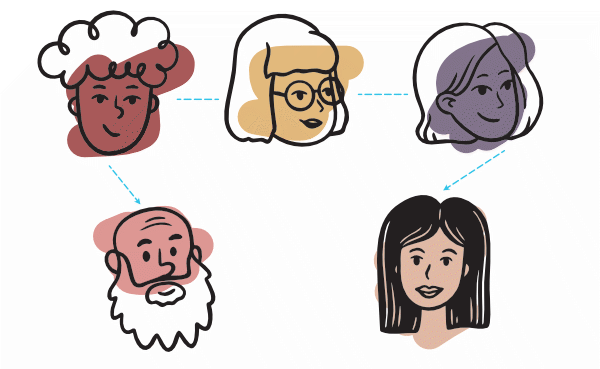
Drawn on a napkin, their polycule looked like a constellation: Lena dates Marco and Priya; Marco also dates Sam; Priya has a long-distance partner in another city. Five people, several different relationships, one interconnected web.
Metamour
Your partner's other partner—someone you're connected to through a shared partner, not by dating them yourself.Metamour relationships range from close friendship to polite distance to barely any contact at all.
Carlos had been nervous about meeting Wren, his girlfriend's other partner. Over tacos, the dread evaporated—Wren was funny and kind, and they bonded over both loving the same impossible person. "My metamour turned into one of my favorite people," he laughed.
Network styles
Kitchen table polyamory (KTP)
A style where everyone in the network is comfortable enough to gather around the same table—literally or figuratively—sharing meals, holidays, and friendship. The relationships are integrated into one shared life.
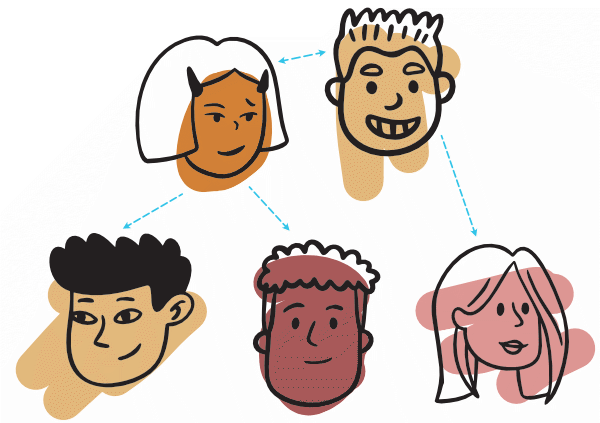
Every Thanksgiving, Aisha hosts the whole polycule: her two partners, one partner's girlfriend, and assorted metamours. The kids call all of them by name. "It's loud and it's wonderful," she says. "That's kitchen table for us."
Parallel polyamory
A style where each relationship runslargely independently of the others, with little or no contact between metamours. There's nothing dysfunctional about it—it's simply a preference for keeping connections separate.

Sofia's two partners have never met and have no desire to. Each relationship has its own rhythm, its own inside jokes, its own world. "I'm not hiding anyone," she explains. "We just like our lanes parallel, not merged."
Non-hierarchical polyamory
A structure with no partner officially ranked above another. Practical differences may exist (one partner you live with, another you see monthly), but the language and decision-making avoid placing anyone "above" or "below."
Eli and their partners deliberately avoid words like "primary." When a big decision comes up—a move, a new commitment—everyone affected has a real voice. "Different relationships, different shapes," Eli says, "but nobody's the runner-up."
Solo polyamory (solo poly)
A way of practicing polyamory in which you remain your own primary partner—often living independently, keeping finances separate, and choosing not to merge your life into a couple unit, even while having deeply committed relationships. The emphasis is on autonomy, not a lack of seriousness or capacity for love.

After a marriage that left her feeling erased, Daniela rebuilt her life on her own terms: her own apartment, her own name on everything, two partners she adores and zero plans to move in with either. "I'm the center of my own life now," she says. "Solo poly gave me a word for that."
Poly by orientation
The experience of polyamory asa core part of one's identity rather than a lifestyle choice—the sense that loving multiple people is simply how one is wired, not a phase or a decision that could easily go the other way.

For Sam, monogamy always felt like holding his breath. "It's not that I chose poly off a menu," he says. "It's that being open to loving more than one person is just... me. It's orientation, not preference."
Feelings and practices
New relationship energy (NRE)
The intoxicating rush of excitement, infatuation, and obsessive focus that comes with a new romantic connection; butterflies, constant texting, a partner who suddenly seems to glow. It's universal to new love, but it gets named in polyamory because it can unintentionally pull energy away from existing partners if you're not paying attention.

Three weeks into dating Kai, Morgan was floating—and slowly, their long-term partner Reese started feeling like furniture. They named it together: "This is NRE. It's real, it's fun, and I still need our Friday nights." The fog had a name, so it had a remedy.
Fluid bonding
The decision to have barrier-free sex with a partner, exchanging bodily fluids. In non-monogamy it's usually a deliberate, negotiated choice tied to trust, STI testing, and agreements with everyone affected—sometimes carrying real symbolic weight as a marker of commitment.
Before deciding to stop using condoms, Priya and her partner sat down with their other partners, shared recent test results, and talked through everyone's comfort. "Fluid bonding wasn't just a sex decision," she said. "It was a whole-network conversation about trust."
Terms to approach with care
Some vocabulary describes practices that are common but frequently criticized within the community, usually because they can tip into treating someone as less than a full person. Knowing the words helps you recognize the dynamics.
Unicorn
A (usually bisexual) person, often a woman, sought by an established couple to join their relationship—dating both partners equally and on the couple's terms. The mythical name hints at the issue: such a person, willing to slot neatly into someone else's arrangement with no needs of their own, is rare and often idealized.
Unicorn hunting
The practice of a couple searching for that third person. It's widely critiqued in poly communities because it tends to privilege the couple's goals over the third partner's autonomy—dictating who they can see, how the relationship can grow, and when it ends.

Bea matched with a married couple who had a long list of rules: she had to date both of them, couldn't have other partners, and could be "let go" if either of them got uncomfortable. "I realized I wasn't a person to them," she said. "I was a missing puzzle piece. That's the unicorn-hunting trap."
Veto power
An agreement giving one partner the ability to require their partner to end another relationship. It shows up most in hierarchical setups. Some couples find an early veto reassuring; many experienced poly people consider it risky, because it can override a third partner's feelings entirely and be used to control rather than protect.
Early on, Tom and his wife gave each other veto power—it felt safe. A year later, when his wife vetoed someone simply because she felt insecure, Tom watched a kind person get hurt by a rule he'd agreed to without thinking. They renegotiated: less veto, more honest conversation.
Don't ask, don't tell (DADT)
An arrangement where partners are permitted to see other people as long as it'snever discussed or disclosed. Some couples prefer the privacy; critics note it can sit in tension with the transparency most ethical non-monogamy depends on, and can leave outside partners invisible.

Elena and her husband chose DADT—she genuinely didn't want details. It worked for a while, until a scheduling mix-up made the silence feel more like secrecy. "For us, not knowing eventually felt worse than knowing," she said. "But I have friends for whom it works beautifully. It really depends on the people."
Putting it together
You don't need to adopt any of these labels to benefit from them. Their real value is precision: it's far easier to say "I'm dealing with some NRE and need a little reassurance" than to fumble through the feeling with no name for it. As you keep exploring, remember that no term obligates you to a particular structure, and the same word can mean slightly different things to different people. When in doubt, define your terms with the person in front of you.
Curious where these structures come from and how people choose among them? Read our companion guide on the types of ethical non-monogamy, and if you're navigating the feelings underneath the vocabulary, our piece on attachment, anxiety, and polyamory digs deeper.
Frequently asked questions
-
A metamour is one specific person—your partner's other partner. A polycule is the entire connected network of people linked through their relationships, which includes you, your partners, and your metamours.
-
No. A solo poly person can have multiple deeply committed relationships; what makes it "solo" is choosing to stay independent—living alone, keeping finances separate—rather than merging into a couple unit.
-
Not inherently illegal or forbidden, but both are frequently criticized because they can prioritize an existing couple's comfort over another partner's autonomy and wellbeing. Many experienced polyamorous people avoid them for that reason.
-
Not at all. The terms exist to make communication clearer and to help you find community and resources. They're tools, not identities you're required to claim.